

Automotive Windshield Recycling How Glass and PVB Are Separated
End-of-life automotive windshields are laminated safety glass, typically consisting of two glass layers bonded with a PVB (polyvinyl butyral) interlayer. Unlike ordinary glass waste, they cannot be efficiently recycled through simple crushing. The main challenge is to separate the glass and PVB into usable material streams with low cross-contamination.
How Scrap Windshield Recycling Works A typical recycling process may include pre-pressing or pre-crushing, feeding, glass/PVB separation, screening and separate material discharge. Dust collection can be added to control airborne particles during processing. Windshields vary in size, thickness and curvature and may contain rubber edges or metal fittings, so preprocessing requirements depend on the system design. The material must be reduced to a suitable particle size that allows the glass-PVB bond to be broken without excessive contamination. The separation stage determines the quality of the recovered materials. Recyclers generally require glass cullet with low PVB content and PVB with limited residual glass. Excessive crushing can increase contamination, while insufficient processing can leave too much PVB attached to the glass.
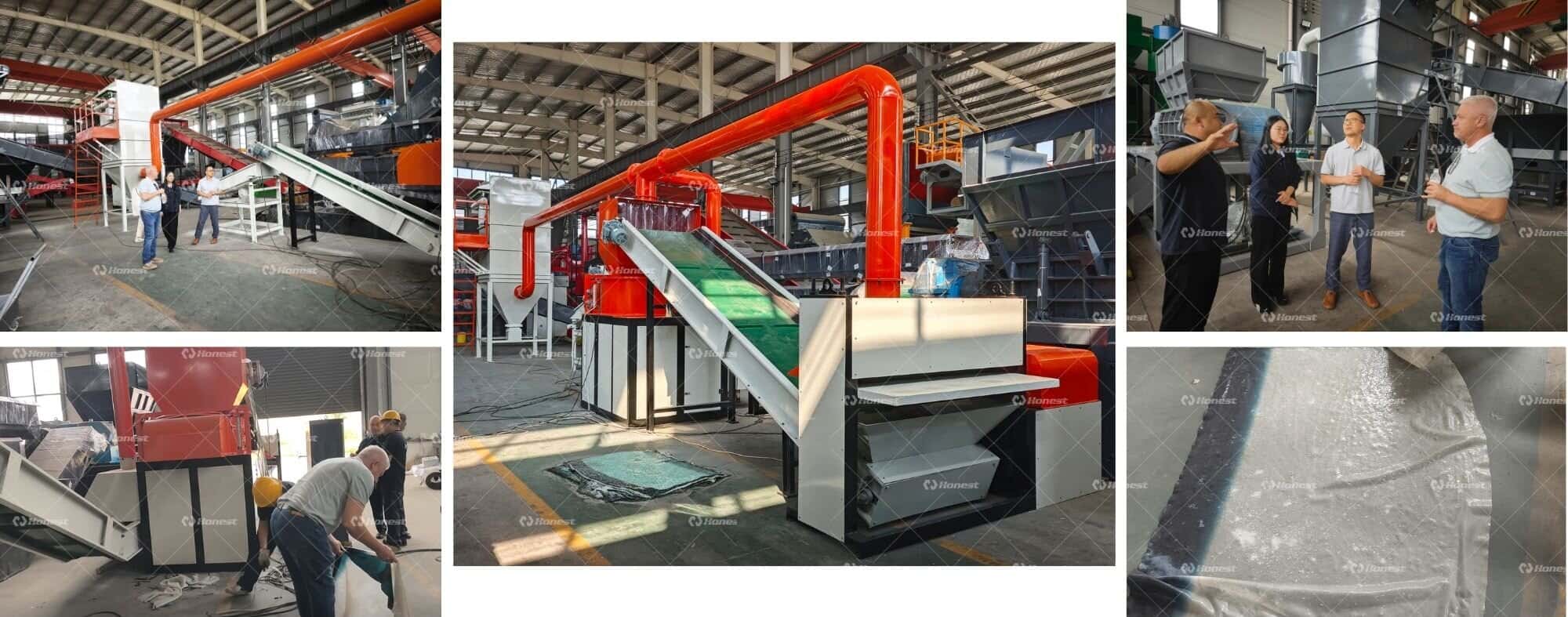 Automotive Windshield Recycling Machine
What to Check Before Buying a Windshield Recycling Machine Base machine selection on actual processing performance rather than motor power or nominal capacity alone. Buyers should confirm the tested capacity on used automotive windshields, acceptable input dimensions and thickness, compatibility with curved glass, required preprocessing, final glass particle size and separation performance. It is also important to check what is included in the quotation. Conveyors, screens, dust collectors, electrical controls and discharge systems may be quoted separately and can significantly affect the total investment. For complete projects, installation, commissioning, operator training, spare parts and technical support should also be considered.
Choosing the Right Recycling System Small recyclers may prefer compact systems with manual feeding and lower throughput to reduce initial investment. Larger operations may require continuous feeding, automated material handling, dust extraction and PLC control. The most reliable way to evaluate a system is through testing with actual end-of-life windshields. A complete test from feeding to final glass and PVB discharge provides a clearer indication of capacity, particle size and separation quality than individual machine specifications. Ultimately, windshield recycling is not simply a crushing process. Its value depends on how effectively the system separates glass and PVB and produces materials suitable for further processing or reuse.
👉 Contact Tel: +86 199 0388 6476
👉 Contact Email: hnhonest.zack@gmail.com
Related News
- Double Shaft Shredder Processes Mixed Plastic Waste
- Laminated Glass Recycling Line Key Technical Considerations
- Automotive Windshield Recycling How Glass and PVB Are Separated
- How Is Automotive Scrap Recycled? A Practical Guide
- Deploys Advanced Beverage Carton Recycling Line in Meerut, India
- Solar Panel Recycling Process From PV Module to Recovered Materials

Have this news-related demand?
We can help you!
Get in Touch
Connect with us anytime! Whether you have questions, need project assistance, or seek general help, our dedicated team is ready to assist. Fill out the form, and we'll promptly prioritize your satisfaction. We eagerly anticipate serving you.
If you have any requirement or suggestion, please fill in the form and send to us, thanks!
Email: hnhonest.zack@gmail.com
WhatsApp: +86 19903886476
Address: No. 403, South Of Floor 4, No. 172, Fifth Street, Zhengzhou Economic And Technological Development Zone Zhengzhou Henan China
HONEST - Experts in Waste Recycling Solutions
40000
m²
Equipment R&D Factory
2500+
Cases
Customers Worldwide
150+
Countries
Over 20 years manufacturing and 14 years export


