

How Scrap Cans Become High-Value Raw Materials Again
With the growing global focus on sustainability, aluminum recycling has become one of the most effective and profitable areas within the metal recycling industry. Used beverage cans, often treated as disposable waste, are actually a valuable secondary raw material that can be efficiently recycled into high-quality aluminum products using far less energy than is required for primary production.
Why Aluminum Recycling Matters Aluminum is one of the few materials that can be recycled repeatedly without significant loss of performance. Compared to primary aluminum production, recycling scrap aluminum requires only about 5% of the energy, making it both environmentally and economically advantageous. This is why industries worldwide are investing in advanced aluminum recycling systems and scrap metal processing technologies.
The Science Behind Aluminum Decoating Technology—UBC De-Coating Furnace Modern systems use a combination of thermal decomposition and mechanical action: the decoating process operates at 450-600°C in a low-oxygen environment. At this temperature range—below aluminum’s melting point but above the decomposition point of coatings—organic materials break down into combustible gases and minimal carbon residue. Inside a rotating furnace, aluminum fragments continuously tumble and collide. This motion causes the now brittle, carbonized coating layer to detach from the metal surface. In simple terms: Heat weakens the coating, and movement removes it.
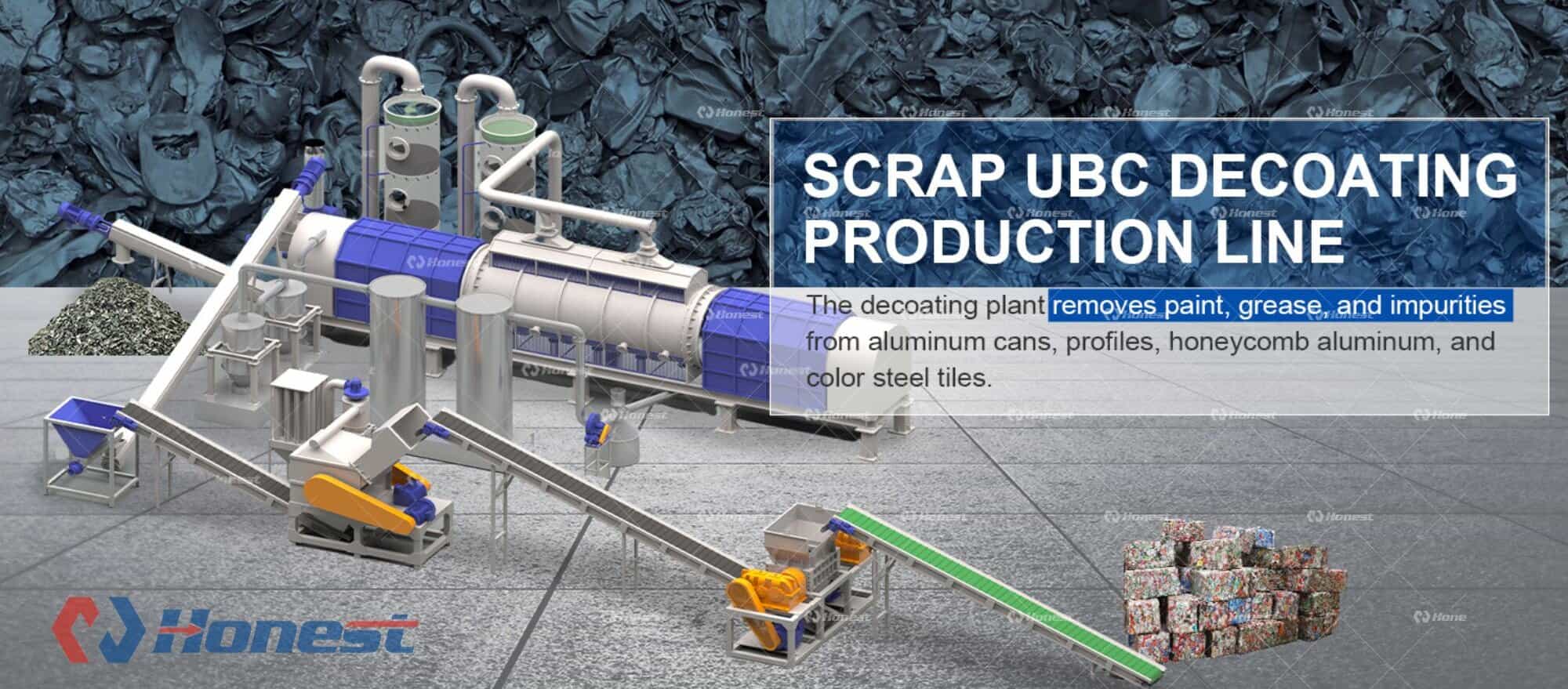 UBC De-Coating Production Line
Material Flexibility and Metal Loss Control in Modern Recycling Systems Modern decoating and recycling systems are designed to process far more than aluminum cans, offering strong compatibility with a wide range of coated non-ferrous materials such as aluminum profiles and scrap, coated aluminum sheets, copper wires with insulation or paint, and mixed non-ferrous metal scrap. To maintain consistent processing performance across different materials, operators typically adjust parameters such as temperature, retention time, and airflow conditions. Metal loss remains one of the most critical performance indicators in recycling operations; however, in a properly controlled system, total metal loss is generally maintained between 0.5% and 2%, while advanced systems with optimized temperature control, low oxygen environments, reliable sealing structures, and stable operation can further reduce loss to below 1%, improving overall material recovery and economic return.
👉 Contact Tel: +86 199 0388 6476
👉 Contact Email: hnhonest.zack@gmail.com
Related News
- Solar Panel Recycling Process From PV Module to Recovered Materials
- ASR Recycling Machine: How Automotive Shredder Residue Is Processed
- What Is Automotive Shredder Residue and How Is It Recycled
- What Materials Can a Spiral Shredder Process
- How Are Aluminum Frames Removed From Solar Panels
- How to Recycle Beverage Bottles with Liquid Inside

Have this news-related demand?
We can help you!
Get in Touch
Connect with us anytime! Whether you have questions, need project assistance, or seek general help, our dedicated team is ready to assist. Fill out the form, and we'll promptly prioritize your satisfaction. We eagerly anticipate serving you.
If you have any requirement or suggestion, please fill in the form and send to us, thanks!
Email: hnhonest.zack@gmail.com
WhatsApp: +86 19903886476
Address: No. 403, South Of Floor 4, No. 172, Fifth Street, Zhengzhou Economic And Technological Development Zone Zhengzhou Henan China
HONEST - Experts in Waste Recycling Solutions
40000
m²
Equipment R&D Factory
2500+
Cases
Customers Worldwide
150+
Countries
Over 20 years manufacturing and 14 years export


