

Waste Tire Recycling Working Process and Equipment
Every year, billions of tires reach the end of their service life, creating one of the world’s largest recyclable rubber waste streams. Scrap tires come from a wide range of industries and transportation sectors, including passenger cars, trucks and buses, construction and mining vehicles, agricultural machinery, motorcycles, bicycles, aircraft tires, and industrial transport equipment. Due to differences in size, structure, and steel content, each type of waste tire requires an efficient and adaptable recycling solution to maximize material recovery.
To address this challenge, modern tire recycling focuses on converting waste tires into valuable recycled products such as rubber granules, rubber powder, recovered steel wire, and fiber materials. The standard recycling process typically includes shredding, crushing, steel wire separation, magnetic separation, fiber separation, and fine grinding. Through this process, rubber and metal can be effectively separated, improving both recycling purity and commercial value while reducing environmental pollution caused by landfilling or open burning.
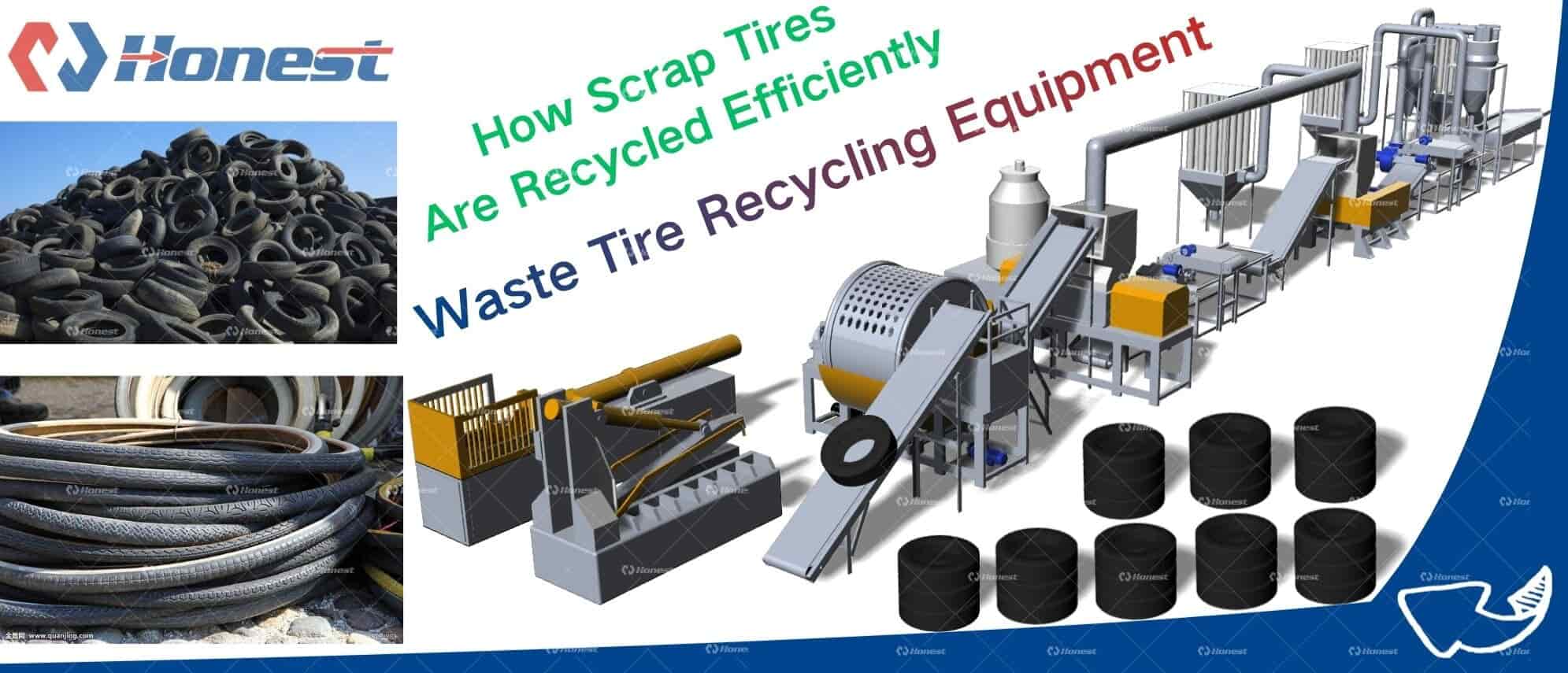 Waste Tire Recycling Equipment
How Scrap Tires Are Recycled Efficiently In practice, a fully automatic tire recycling production line generally works through the following process. First, a steel wire drawing machine removes the bead wires from the tire sidewall. Next, the tire shredder cuts whole tires into 3–8 cm rubber blocks. A steel wire separator further separates rubber from steel while reducing the material into 10–15 mm rubber granules. Magnetic separators then remove remaining steel wire from the mixture, followed by a rubber granulator that crushes the material into 0–4 mm rubber powder or granules. Finally, a fiber separator removes nylon fiber and light impurities. The result is a cleaner finished rubber material suitable for reuse in rubber products, sports surfaces, paving materials, and other industrial applications.
For oversized tires such as OTR and mining tires, a pre-treatment stage is often required before shredding. This usually includes tire cutting and bead wire pulling, which helps reduce processing difficulty and improves the efficiency of downstream crushing equipment. By removing large steel wires in advance, the recycling system can achieve smoother operation, reduced machine wear, and more stable production capacity.
👉 Contact Tel: +86 199 0388 6476
👉 Contact Email: hnhonest.zack@gmail.com
Related News
- Henan Honest 2026 National Day Holiday Schedule
- Copper Wire Granulator Uses Crushing and Gravity Separation
- Double Shaft Shredder Processes Mixed Plastic Waste
- Laminated Glass Recycling Line Key Technical Considerations
- Automotive Windshield Recycling How Glass and PVB Are Separated
- How Is Automotive Scrap Recycled? A Practical Guide

Have this news-related demand?
We can help you!
Get in Touch
Connect with us anytime! Whether you have questions, need project assistance, or seek general help, our dedicated team is ready to assist. Fill out the form, and we'll promptly prioritize your satisfaction. We eagerly anticipate serving you.
If you have any requirement or suggestion, please fill in the form and send to us, thanks!
Email: hnhonest.zack@gmail.com
WhatsApp: +86 19903886476
Address: No. 403, South Of Floor 4, No. 172, Fifth Street, Zhengzhou Economic And Technological Development Zone Zhengzhou Henan China
HONEST - Experts in Waste Recycling Solutions
40000
m²
Equipment R&D Factory
2500+
Cases
Customers Worldwide
150+
Countries
Over 20 years manufacturing and 14 years export


