

Lithium Battery Recycling Equipment and Process Explained
The rapid growth of electric vehicles, energy storage systems, and portable electronics has created a growing challenge: how to safely recycle millions of used lithium batteries. Unlike traditional metal waste, lithium batteries contain valuable materials such as lithium, nickel, cobalt, copper, aluminum, and graphite, but their complex structure and residual energy make recycling more demanding. Modern lithium battery recycling equipment is designed to safely process waste batteries while recovering valuable materials through a combination of mechanical treatment, thermal processing, and advanced separation technologies.
For industrial-scale lithium-ion battery recycling projects, recovery rate and product purity are only part of the equation. Safety, emissions control, energy consumption, and long-term operating stability are equally important. A commercial recycling plant must continuously process large volumes of batteries while handling diverse battery types and operating conditions. Therefore, safe shredding, reliable thermal treatment, and efficient separation technologies are essential for stable production.
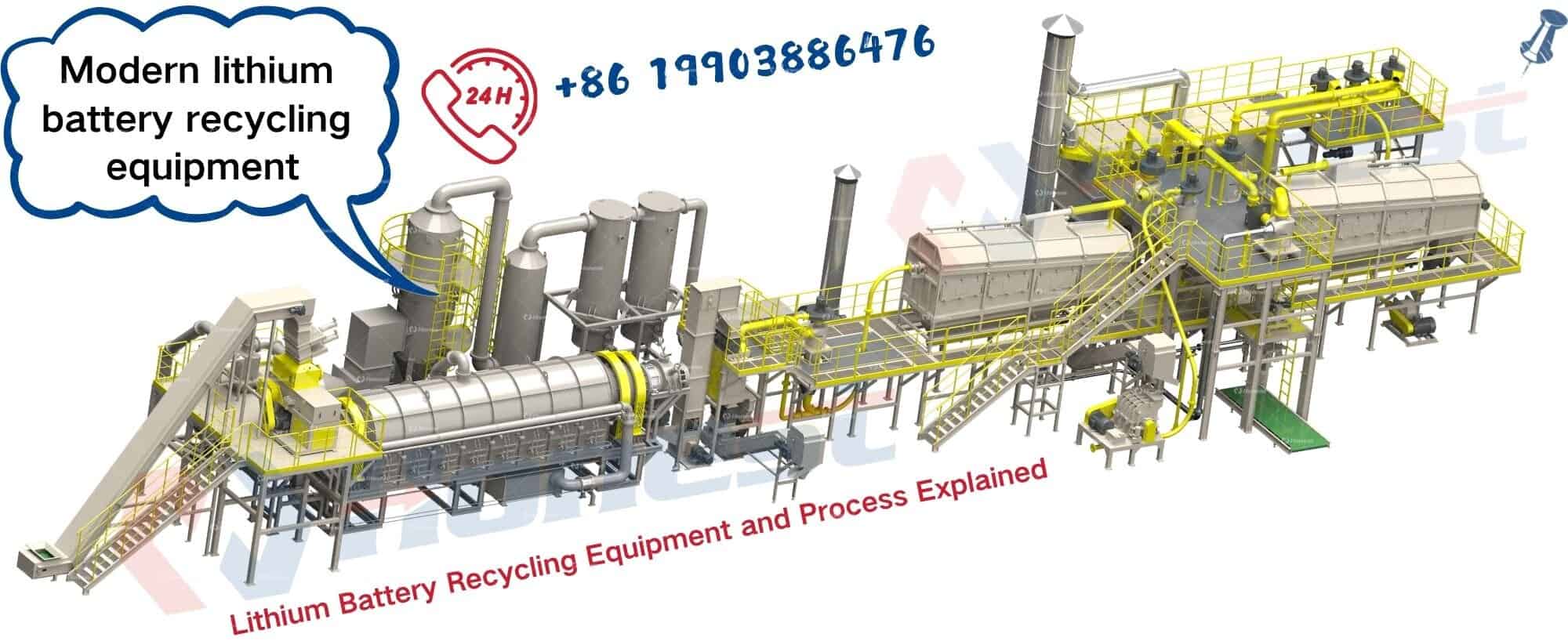 Modern lithium battery recycling equipment
How Does Lithium Battery Recycling Equipment Work Modern lithium battery recycling equipment combines mechanical processing, controlled pyrolysis, and multi-stage separation technologies to recover valuable resources from waste batteries. The process usually begins with a nitrogen-protected shredder that reduces battery modules and cells into smaller pieces while minimizing the risk of fire and unwanted reactions. The shredded materials are then transferred to a pyrolysis system, where heat removes electrolyte, separator films, and organic binders, producing a concentrated electrode material mixture. During pyrolysis, generated gases are treated through an exhaust purification system. Thermal oxidation, cooling, scrubbing, and adsorption technologies work together to reduce harmful emissions and improve environmental performance. Advanced battery recycling systems can also utilize recovered process heat to improve energy efficiency and reduce operating costs. After thermal treatment, the remaining materials enter a multi-stage separation process. Crushing and grinding help release black mass from electrode materials, while magnetic separation, air separation, screening, and density-based sorting separate steel, copper, and aluminum components. ★ Black mass containing valuable battery materials such as nickel, cobalt, lithium compounds, and graphite ★ Copper materials recovered from current collectors ★ Aluminum materials from battery casings and electrodes ★ Steel and other structural materials
A complete lithium-ion battery recycling system integrates charged battery shredding, pyrolysis technology, exhaust treatment, heat recovery, and advanced metal separation into one continuous process. Through optimized thermal management and intelligent sorting technology, recycling plants can improve resource recovery efficiency while maintaining safer operation and better economic performance.
👉 Contact Tel: +86 199 0388 6476
👉 Contact Email: hnhonest.zack@gmail.com
Related News
- Deploys Advanced Beverage Carton Recycling Line in Meerut, India
- Solar Panel Recycling Process From PV Module to Recovered Materials
- ASR Recycling Machine: How Automotive Shredder Residue Is Processed
- What Is Automotive Shredder Residue and How Is It Recycled
- What Materials Can a Spiral Shredder Process
- How Are Aluminum Frames Removed From Solar Panels

Have this news-related demand?
We can help you!
Get in Touch
Connect with us anytime! Whether you have questions, need project assistance, or seek general help, our dedicated team is ready to assist. Fill out the form, and we'll promptly prioritize your satisfaction. We eagerly anticipate serving you.
If you have any requirement or suggestion, please fill in the form and send to us, thanks!
Email: hnhonest.zack@gmail.com
WhatsApp: +86 19903886476
Address: No. 403, South Of Floor 4, No. 172, Fifth Street, Zhengzhou Economic And Technological Development Zone Zhengzhou Henan China
HONEST - Experts in Waste Recycling Solutions
40000
m²
Equipment R&D Factory
2500+
Cases
Customers Worldwide
150+
Countries
Over 20 years manufacturing and 14 years export


