

AC Radiator Stripping Machine Overview and Working Principle
AC radiator stripping machines are essential in recycling operations for recovering copper and aluminum from scrap radiators. With simple structure, stable performance, and low operating costs, they deliver fast processing, high recovery rates, and minimal material loss, enabling direct resale at premium prices for a variety of radiator types.
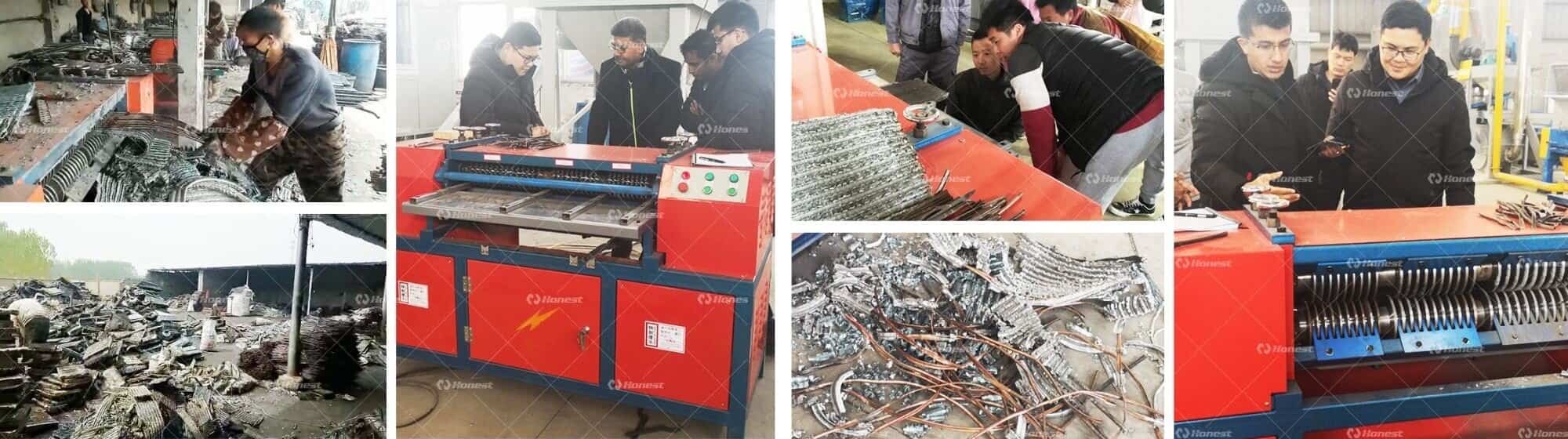
What Is an AC Radiator Stripping Machine ? An AC radiator stripping machine, also called a radiator separator or copper-aluminum separator, specializes in recovering valuable copper and aluminum from scrap air conditioner radiators, car radiators, and refrigeration heat exchangers. The machine mechanically separates aluminum fins from copper tubes without damaging either metal, achieving up to 99% separation purity. By recovering clean copper and aluminum, recyclers can significantly increase scrap material value, improve recycling efficiency, and reduce manual labor.
AC Radiator Stripping Machine OverviewHow the Machine Works The machine processes flat, non-deformed radiators through dedicated feeding inlets matched to different copper tube spacings, typically 19 mm, 21 mm, and 25 mm. During operation, the radiator is fed into the correct inlet, where internal blades, rollers, and feeding gears strip the aluminum fins away from the copper tubes. The separated copper pipes and aluminum are then discharged independently for easy collection and resale. Standard models are ideal for single-layer radiators, while double-layer radiators can also be processed after removing the lower blade cover and adjusting the feeding position correctly. Depending on the model and material condition, processing capacity generally ranges from 200–300 kg per hour or higher.
Material Requirements for Efficient Separation To ensure stable operation and clean separation, the radiators must meet several preparation requirements before processing. First, the iron radiator heads on both sides must be removed. Oversized radiators should be cut with a bandsaw to match the inlet width, and radiators with more than two layers should be separated into single-layer or double-layer sections. Operators must always feed materials into the correct inlet size to avoid damaging the copper tubes or reducing separation quality. Twisted or heavily deformed radiators cannot be processed effectively. During feeding, the radiator must remain aligned with the guide ruler so that each feeding gear enters precisely between two copper tubes, ensuring smooth stripping and high-purity output.
👉 Contact Tel: +86 199 0388 6476
👉 Contact Email: hnhonest.zack@gmail.com
Related News
- Henan Honest 2026 National Day Holiday Schedule
- Copper Wire Granulator Uses Crushing and Gravity Separation
- Double Shaft Shredder Processes Mixed Plastic Waste
- Laminated Glass Recycling Line Key Technical Considerations
- Automotive Windshield Recycling How Glass and PVB Are Separated
- How Is Automotive Scrap Recycled? A Practical Guide

Have this news-related demand?
We can help you!
Get in Touch
Connect with us anytime! Whether you have questions, need project assistance, or seek general help, our dedicated team is ready to assist. Fill out the form, and we'll promptly prioritize your satisfaction. We eagerly anticipate serving you.
If you have any requirement or suggestion, please fill in the form and send to us, thanks!
Email: hnhonest.zack@gmail.com
WhatsApp: +86 19903886476
Address: No. 403, South Of Floor 4, No. 172, Fifth Street, Zhengzhou Economic And Technological Development Zone Zhengzhou Henan China
HONEST - Experts in Waste Recycling Solutions
40000
m²
Equipment R&D Factory
2500+
Cases
Customers Worldwide
150+
Countries
Over 20 years manufacturing and 14 years export


