

Detailed Overview of Recycling Equipment for Bifacial PV Panel
For more than a decade, most photovoltaic waste has originated from early-generation single-glass solar modules. Recycling efforts during that period were largely focused on separating aluminum frames, front glass, and polymer backsheet materials. However, the market is now undergoing a rapid structural shift. Future end-of-life photovoltaic waste will increasingly consist of bifacial glass-glass modules rather than traditional single-glass panels. This transition means that recycling systems designed exclusively for legacy modules may soon become inadequate. In practice, equipment that cannot efficiently process bifacial modules is likely to be phased out as the next wave of photovoltaic waste enters the recycling stream.
A typical bifacial module consists of an aluminum frame, tempered front glass, EVA encapsulation layers, silicon solar cells, POE encapsulation, reinforced rear glass, and junction box assemblies. Compared with conventional single-glass modules, the additional glass layer and stronger encapsulation materials significantly increase structural complexity during recycling. The absence of a polymer backsheet and the presence of dual-bonded glass layers create new challenges for mechanical dismantling and material separation.
To address these structural challenges, modern bifacial solar panel recycling solutions are shifting toward continuous automated processing rather than relying on simple crushing approaches. In most advanced systems, operations begin with automated feeding, followed by aluminum frame removal and junction box dismantling before the crushing stage begins. This pre-treatment step is critical, as the early separation of high-value components improves downstream material purity and enhances overall recovery efficiency.
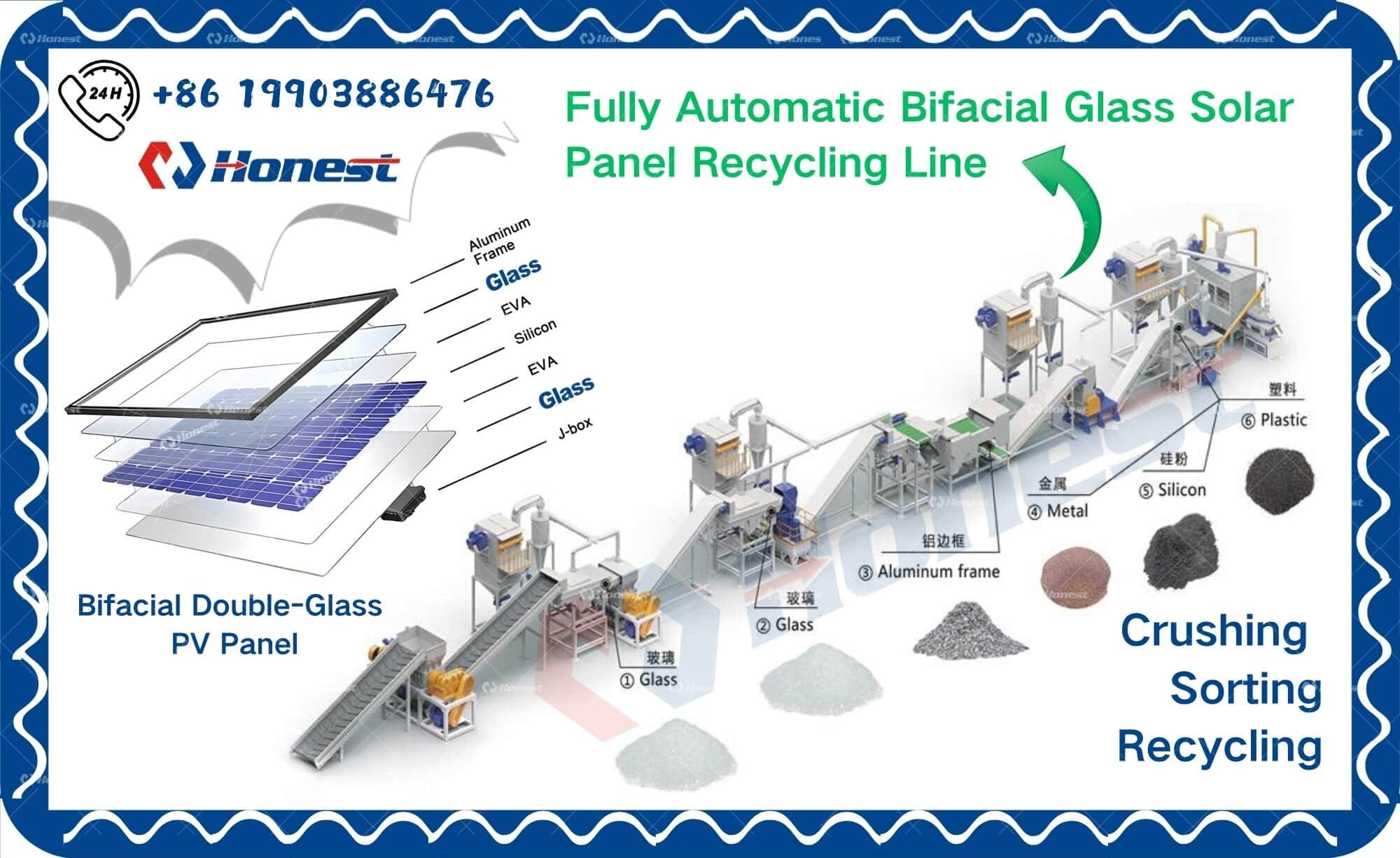 Fully Automatic Bifacial Glass Solar Panel Recycling Line
Primary size reduction is typically carried out using customized double-shaft shredding systems capable of handling complete modules, with or without frames. After coarse shredding, hammer crushers apply controlled impact forces to detach bonded glass from encapsulated cell materials. Multi-stage vibrating screens then classify and recover glass particles, while finer materials proceed to secondary sorting stages.
In aluminum recovery, eddy current separation remains one of the most effective technologies available. By utilizing electromagnetic induction, the separator ejects conductive aluminum from mixed crushed materials. Under stable feeding conditions, aluminum recovery rates can typically reach up to 95%. Once the majority of glass and metals have been recovered, the remaining material stream enters fine crushing and classification stages, where plastics, residual metals, and silicon powder are separated. This staged mechanical design is widely recognized as a key factor in achieving stable throughput when processing glass-glass photovoltaic modules.
This shift explains why many equipment manufacturers are now emphasizing capabilities related to bifacial solar panel recycling, double-glass PV module processing, and glass-glass component recovery. These features are not merely product upgrades; they reflect the direction in which photovoltaic waste management is expected to evolve over the next decade.
The commercial logic behind this transition is straightforward. Bifacial modules contain consistent aluminum value, a higher proportion of recoverable glass, and growing potential for silicon recovery. Although mechanical processing is more demanding, the long-term recovery value can be significantly higher when appropriate separation strategies are applied. For recyclers investing today, the central question is no longer whether bifacial modules require specialized technology, but whether existing systems are prepared to handle the next generation of photovoltaic waste. Bifacial double-glass PV modules consist of a multilayer structure designed for high durability and dual-sided power generation, including an aluminum frame, front tempered glass, EVA encapsulation, bifacial silicon solar cells, POE/EVA back encapsulation, rear tempered glass, and a junction box.
👉 Contact Tel: +86 199 0388 6476
👉 Contact Email: hnhonest.zack@gmail.com
Related News
- Detailed Overview of Recycling Equipment for Bifacial PV Panel
- Inside Aluminum Can Decoating Line: Technology and Output Explained
- Heavy-Duty Crawler Tracked Mobile Shredder for Industrial Recycling
- Detailed Overview of ACSR Recycling Equipment & Steel-Core Aluminum Separation
- How to Recycle Blister Pack Waste Efficiently (Complete Industrial Guide)
- Why UBC Debalers Matter in Aluminum Recycling

Have this news-related demand?
We can help you!
Get in Touch
Connect with us anytime! Whether you have questions, need project assistance, or seek general help, our dedicated team is ready to assist. Fill out the form, and we'll promptly prioritize your satisfaction. We eagerly anticipate serving you.
If you have any requirement or suggestion, please fill in the form and send to us, thanks!
Email: hnhonest.zack@gmail.com
WhatsApp: +86 19903886476
Address: No. 403, South Of Floor 4, No. 172, Fifth Street, Zhengzhou Economic And Technological Development Zone Zhengzhou Henan China
HONEST - Experts in Waste Recycling Solutions
40000
m²
Equipment R&D Factory
2500+
Cases
Customers Worldwide
150+
Countries
Over 20 years manufacturing and 14 years export


