

Advanced Lithium Ion Battery Recycling Line Solution
Driven by the rapid expansion of electric vehicles, energy storage systems, and consumer electronics, global demand for lithium-ion batteries continues to accelerate. Industry data shows that global installed lithium battery capacity exceeded 1,500 GWh in 2024 and is forecast to surpass 4,000 GWh by 2030. At the same time, the average service life of lithium-ion batteries is only 5–8 years, which means a massive wave of end-of-life batteries is now entering the recycling stage. These spent batteries contain high-value and scarce resources such as lithium, cobalt, nickel, manganese, copper, aluminum, and graphite, making lithium-ion battery recycling a strategic industry critical to resource security and sustainable development.
The global lithium-ion battery recycling market reached an estimated value of USD 11 billion in 2024 and is projected to exceed USD 35 billion by 2030, with an annual growth rate of over 20%. A typical lithium-ion battery consists of approximately 30–35% cathode materials, 20–25% anode materials, 15–20% copper, and 7–10% aluminum, along with plastics, separator films, and electrolytes. Efficient recovery of these materials—especially black mass rich in lithium, cobalt, and nickel—offers stable returns and strong scalability, making battery recycling one of the most promising segments in the circular economy.
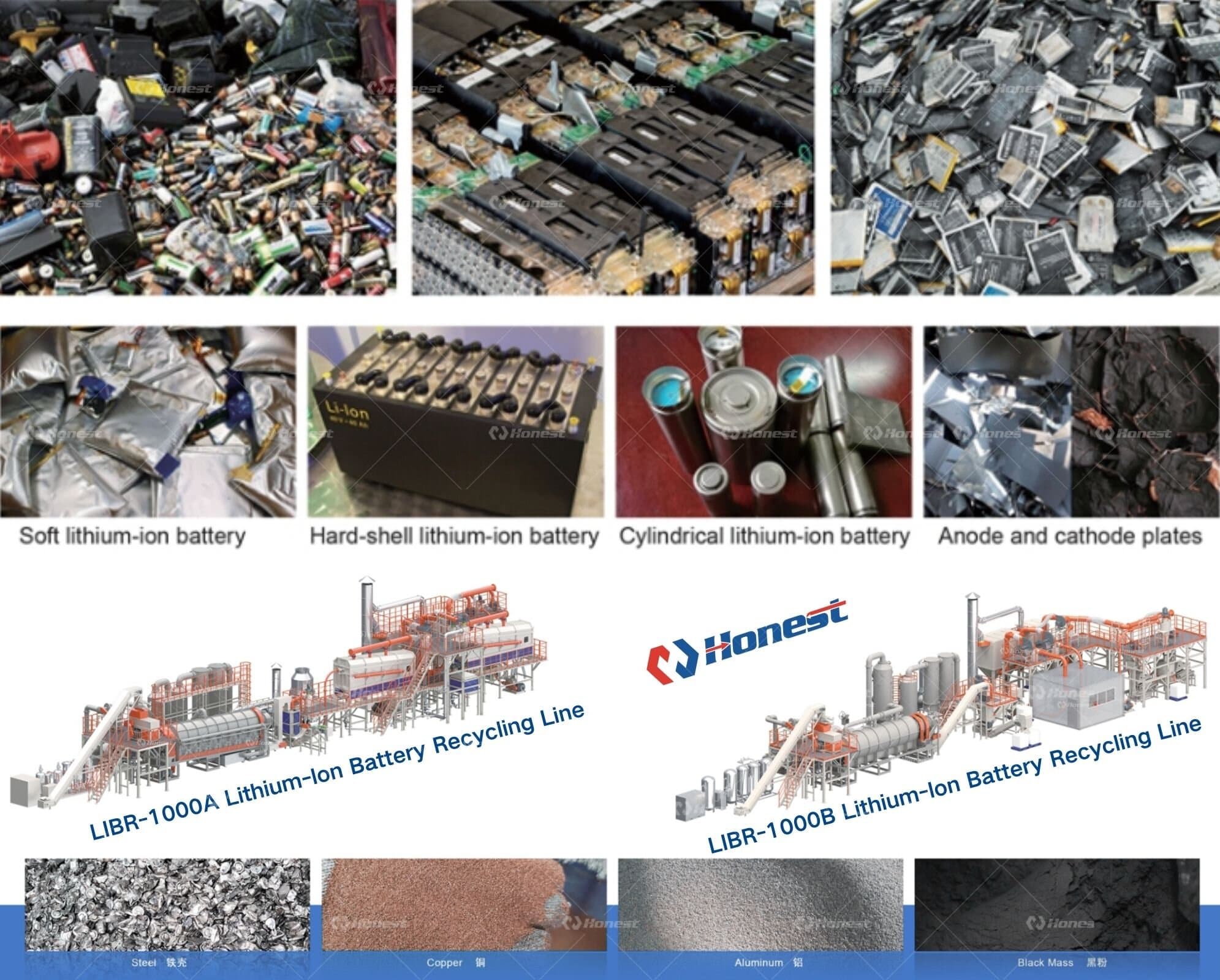
Our lithium-ion battery recycling equipment is designed for safe, efficient, and environmentally responsible material recovery, using an advanced physical separation–based process. The recycling line is suitable for soft-pack batteries, EV power batteries, cylindrical cells, mobile phone batteries, and shell batteries. Through controlled dismantling, crushing, separation, and classification, the system produces high-purity black mass, copper granules, aluminum granules, plastic fractions, iron shells, and separator materials, ensuring maximum overall recovery efficiency while avoiding chemical pollution.
To meet higher safety and efficiency standards, we offer two next-generation recycling solutions based on high-temperature carbonization technology. The fully enclosed carbonization furnace converts organic materials, separators, and hazardous components into stable carbonized substances under controlled conditions, enabling safe downstream processing. An integrated automatic feeding system and multi-stage flue gas purification ensure stable operation, low emissions, and full compliance with environmental regulations. The final outputs include clean metal casings, copper, aluminum, and high-grade black mass suitable for hydrometallurgical refining.
The latest solution adopts an electric-heated carbonization furnace, reducing energy consumption by approximately 50% compared with traditional gas-fired systems, while providing faster and more precise temperature control. A high-speed ultra-fine pulverizer significantly improves black mass liberation, and an aerodynamic screening system enables precise classification through adjustable airflow. The automated copper-aluminum separation system delivers stable, high-purity output, while lower-grade materials are automatically recirculated for re-sorting, ensuring consistently high recovery rates. This represents a revolutionary upgrade in lithium-ion battery recycling equipment, offering recyclers a safer, cleaner, and more profitable solution for large-scale battery recycling.
👉 Contact Tel: +86 199 0388 6476
👉 Contact Email: hnhonest.zack@gmail.com
Related News
- Inside Aluminum Can Decoating Line: Technology and Output Explained
- Heavy-Duty Crawler Tracked Mobile Shredder for Industrial Recycling
- Detailed Overview of ACSR Recycling Equipment & Steel-Core Aluminum Separation
- How to Recycle Blister Pack Waste Efficiently (Complete Industrial Guide)
- Why UBC Debalers Matter in Aluminum Recycling
- PVB Laminated Glass Separator The Definitive Guide to PVB Recovery

Have this news-related demand?
We can help you!
Get in Touch
Connect with us anytime! Whether you have questions, need project assistance, or seek general help, our dedicated team is ready to assist. Fill out the form, and we'll promptly prioritize your satisfaction. We eagerly anticipate serving you.
If you have any requirement or suggestion, please fill in the form and send to us, thanks!
Email: hnhonest.zack@gmail.com
WhatsApp: +86 19903886476
Address: No. 403, South Of Floor 4, No. 172, Fifth Street, Zhengzhou Economic And Technological Development Zone Zhengzhou Henan China
HONEST - Experts in Waste Recycling Solutions
40000
m²
Equipment R&D Factory
2500+
Cases
Customers Worldwide
150+
Countries
Over 20 years manufacturing and 14 years export


