

PVB Laminated Glass Separator The Definitive Guide to PVB Recovery
Automotive windshields and architectural glass consist of a complex bond between glass and Polyvinyl Butyral (PVB). While this structure ensures safety, it traditionally complicates material recovery. Modern industria PVB laminated glassl separators now utilize multi-stage mechanical delamination to achieve high-purity separation, eliminating the need for chemical solvents. This ensures that both the glass cullet and the PVB film meet stringent secondary-market specifications.
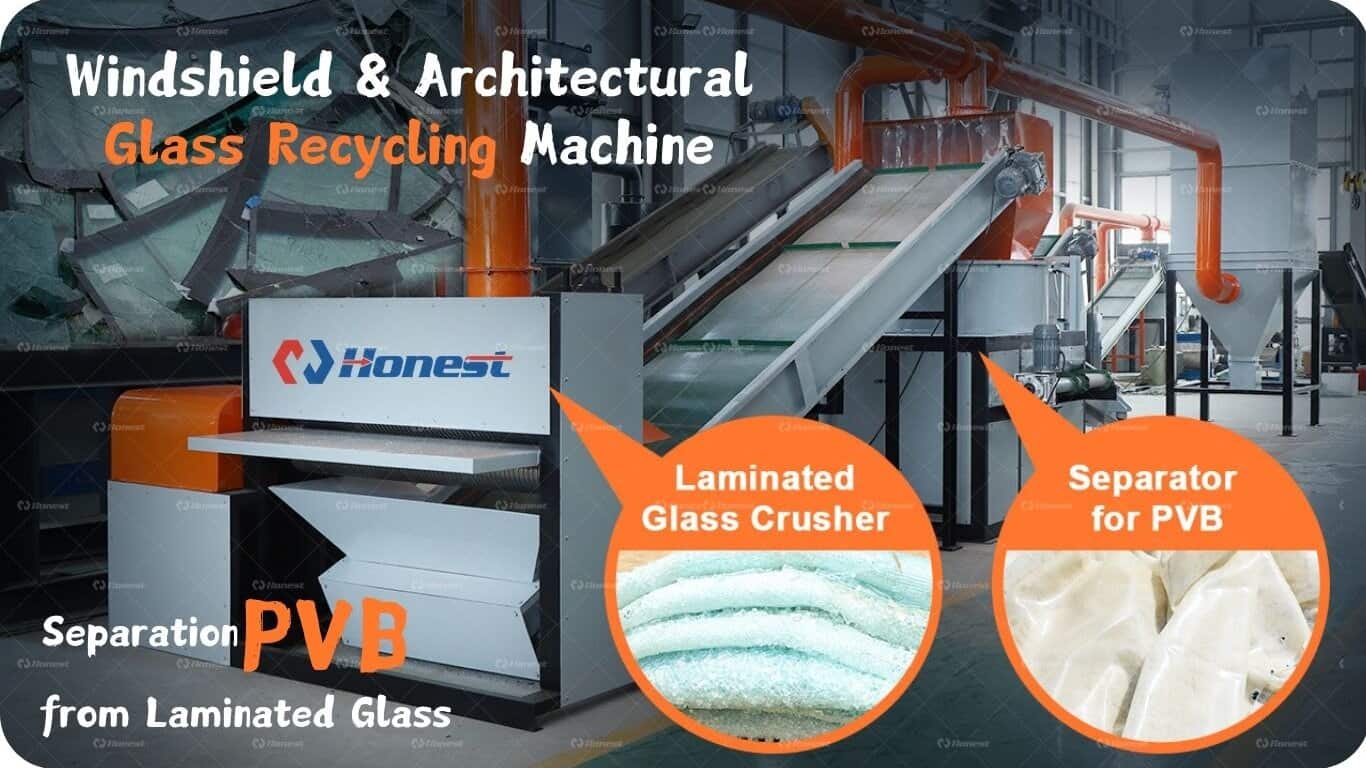 PVB Laminated Glass Separator
The Mechanics of Separation: A Purely Physical Process Unlike primitive crushing methods that contaminate glass with plastic residue, the PVB Laminated Glass Separator employs a refined mechanical peeling principle. The system processes discarded windshields and laminated sheets through a sequence of controlled crushing and differential pressure. By breaking the glass structure while maintaining the integrity of the PVB interlayer, the machine achieves a separation rate exceeding 99%. This process ensures that the glass particles (typically <20 mm) are free of polymer contaminants, while the PVB film remains largely intact for high-value pelletizing or reuse.
| Feature | Industrial Specification |
|---|---|
| Throughput Capacity | 1,000 – 5,000 kg/h |
| Glass Purity Rate | > 99% |
| PVB Integrity | High (Suitable for resale / pelletizing) |
| Output Size (Glass) | < 20 mm (Customizable) |
| Input Compatibility | Automotive Windshields, SGP, EVA, Architectural Laminated Glass |
| Operational Mode | Fully Automated PLC Control |
Engineering Workflow and System Integration A high-capacity car windshield recycling machine (ranging from 1,000 to 5,000 kg/hr) is designed for continuous industrial operation. The workflow begins with automated conveyor feeding, leading into a specialized pre-press unit that weakens the adhesive bond between the layers. In some configurations, a controlled moisture-soaking stage is integrated to further reduce adhesion, though the core separation remains mechanical. The final stage involves high-frequency screening and air classification, which isolates the clean glass cullet from the flexible PVB sheets. This automated approach significantly reduces labor overhead while maintaining consistent throughput.
Sustainability and ROI in Glass Recycling The value proposition of this technology lies in its ability to generate two distinct revenue streams from a single waste source. Clean Glass Cullet : Ready for immediate furnace charging in fiberglass or container glass production. Recovered PVB : A high-demand polymer used in acoustic insulation, carpet backing, and new laminated glass interlayers.
By avoiding chemical additives, the laminated glass separator system operates with a minimal environmental footprint, producing no hazardous wastewater and utilizing integrated dust collection to maintain air quality standards. As landfill costs for automotive scrap continue to rise, these mechanical separation systems provide a critical ROI for glass processors and EOL (End-of-Life) vehicle recyclers.
👉 Contact Tel: +86 199 0388 6476
👉 Contact Email: hnhonest.zack@gmail.com
Related News
- PVB Laminated Glass Separator The Definitive Guide to PVB Recovery
- Gold Deplating Machine for Precious Metal Recovery from E-Waste
- PCB and Copper Clad Laminate Recycling Machine for Crushing and Copper Separation
- How PCB Dismantling Machines Improve Copper Recovery in Recycling
- Cable Granulator Machine for Aluminum or Copper Wire Recycling
- PCB Recycling Value Explained: Where Copper, Gold and Tin Are Located in Waste Circuit Boards

Have this news-related demand?
We can help you!
Get in Touch
Connect with us anytime! Whether you have questions, need project assistance, or seek general help, our dedicated team is ready to assist. Fill out the form, and we'll promptly prioritize your satisfaction. We eagerly anticipate serving you.
If you have any requirement or suggestion, please fill in the form and send to us, thanks!
Email: hnhonest.zack@gmail.com
WhatsApp: +86 19903886476
HONEST - Experts in Waste Recycling Solutions
40000
m²
Equipment R&D Factory
2500+
Cases
Customers Worldwide
150+
Countries
Over 20 years manufacturing and 14 years export


