

Why Lithium-Ion Battery Recycling Is Becoming a Strategic Industry
The rapid rise of lithium-ion battery recycling projects worldwide reflects a major shift in how industries view battery waste. What was once treated as an environmental obligation is now becoming a strategic solution for securing critical raw materials. As electric vehicles and large-scale energy storage systems continue to expand, demand for lithium, cobalt, and nickel is expected to exceed mining capacity within the next decade. Recycling, often described as “urban mining,” provides an alternative supply channel that reduces dependence on primary extraction while helping manufacturers stabilize costs and protect supply chains from market volatility.
At the same time, regulatory pressure and public investment are accelerating the construction of large-scale recycling infrastructure. Many regions are introducing recycled-content requirements for new batteries, along with extended producer responsibility policies that require manufacturers to manage end-of-life products. Landfill restrictions on electric vehicle batteries are also becoming more common, forcing the development of dedicated treatment systems. Supported by government funding and private capital, the lithium-ion battery recycling sector is projected to grow into a multi-billion-dollar global industry by the early 2030s, reflecting both environmental necessity and strong commercial potential.
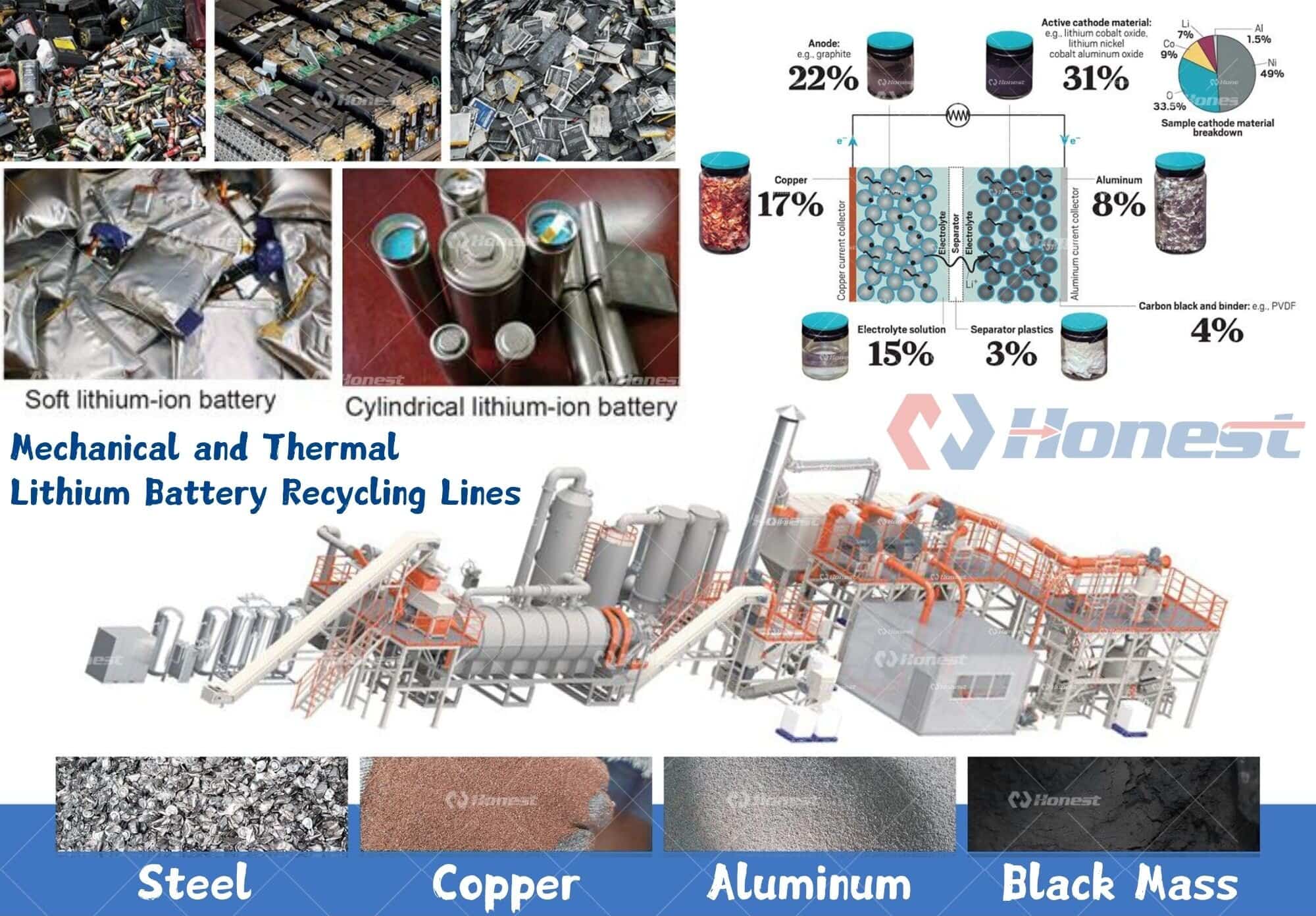 Modern Mechanical and Thermal Lithium Battery Recycling Lines
Behind this growth lies a predictable surge in retired batteries. Global battery installations continue to rise rapidly, while most lithium-ion batteries have lifespans of only five to eight years. As a result, the volume of end-of-life batteries is expected to increase dramatically throughout the next decade. These materials contain significant amounts of nickel, cobalt, manganese, lithium, copper, aluminum, and graphite—often in concentrations higher than those found in natural ore deposits. This composition makes battery recycling not only environmentally beneficial but economically attractive, especially as recovered materials are reintegrated into new battery manufacturing processes.
Modern lithium-ion battery recycling systems are designed around staged processing strategies that combine thermal stabilization with mechanical separation. In many operations, batteries first undergo controlled thermal treatment to neutralize organic components and reduce safety risks. After stabilization, mechanical crushing, milling, and classification technologies are used to separate structural metals such as copper, aluminum, and steel, as well as fine electrode materials. Airflow-based sorting and closed-loop circulation systems further enhance material purity and improve recovery efficiency. This combination of thermal and mechanical processing has become the dominant technical pathway for safely handling mixed battery formats, including electric vehicle packs and consumer electronics batteries.
Among all recovered materials, black mass has emerged as the central economic driver of lithium-ion battery recycling. This powder contains valuable metals such as lithium, cobalt, nickel, and manganese, which can be refined and reused in the production of new batteries. In addition to black mass, recovered copper and aluminum provide stable secondary revenue streams, strengthening overall project economics. As global demand for battery metals continues to rise, recycling is increasingly viewed not as waste treatment, but as a long-term resource strategy. Facilities capable of efficient material recovery and stable output will play a decisive role in supporting the transition toward circular battery supply chains.
👉 Contact Tel: +86 199 0388 6476
👉 Contact Email: hnhonest.zack@gmail.com
Related News
- What Do Construction and Municipal Solid Waste Recycling Equipment Do?
- Why Lithium-Ion Battery Recycling Is Becoming a Strategic Industry
- Detailed Overview of Recycling Equipment for Bifacial PV Panel
- Inside Aluminum Can Decoating Line: Technology and Output Explained
- Heavy-Duty Crawler Tracked Mobile Shredder for Industrial Recycling
- Detailed Overview of ACSR Recycling Equipment & Steel-Core Aluminum Separation

Have this news-related demand?
We can help you!
Get in Touch
Connect with us anytime! Whether you have questions, need project assistance, or seek general help, our dedicated team is ready to assist. Fill out the form, and we'll promptly prioritize your satisfaction. We eagerly anticipate serving you.
If you have any requirement or suggestion, please fill in the form and send to us, thanks!
Email: hnhonest.zack@gmail.com
WhatsApp: +86 19903886476
Address: No. 403, South Of Floor 4, No. 172, Fifth Street, Zhengzhou Economic And Technological Development Zone Zhengzhou Henan China
HONEST - Experts in Waste Recycling Solutions
40000
m²
Equipment R&D Factory
2500+
Cases
Customers Worldwide
150+
Countries
Over 20 years manufacturing and 14 years export


