

LDPE Film Recycling with Spiral Shredder Technology for Soft Plastic Waste
Across modern plastics recovery facilities, few materials disrupt production as consistently as low-density polyethylene (LDPE) film waste. Used in everything from supermarket carrier bags and courier mailers to pallet stretch wrap, agricultural mulch film, and industrial packaging liners, LDPE is one of the most widely consumed flexible plastics in global circulation. Yet its very advantages in packaging—light weight, elasticity, tear resistance, and softness—also make it one of the most technically difficult materials to process after disposal. For recyclers, LDPE often arrives in loose, low-bulk volumes that occupy storage space, carry contamination, and behave unpredictably once introduced into conventional size-reduction systems.
The difficulty begins with material behavior inside traditional shredding chambers. Unlike rigid plastics such as HDPE containers or polypropylene crates, LDPE film does not fracture cleanly under high-speed cutting. Instead, it stretches, folds, wraps around rotating shafts, and forms bridges above the cutting zone, interrupting feed continuity and forcing repeated operator intervention. Agricultural LDPE creates an even heavier burden because collected film frequently contains soil, sand, moisture, and plant residue. Industrial stretch film may include labels, adhesives, or mixed polymer contamination. When the first reduction stage becomes unstable, downstream washing, separation, and pelletizing efficiency decline sharply, making front-end preparation one of the most critical control points in film recycling economics. As e-commerce packaging volumes and agricultural film consumption continue to rise globally, stable LDPE pre-processing has become a strategic requirement rather than a simple mechanical task.
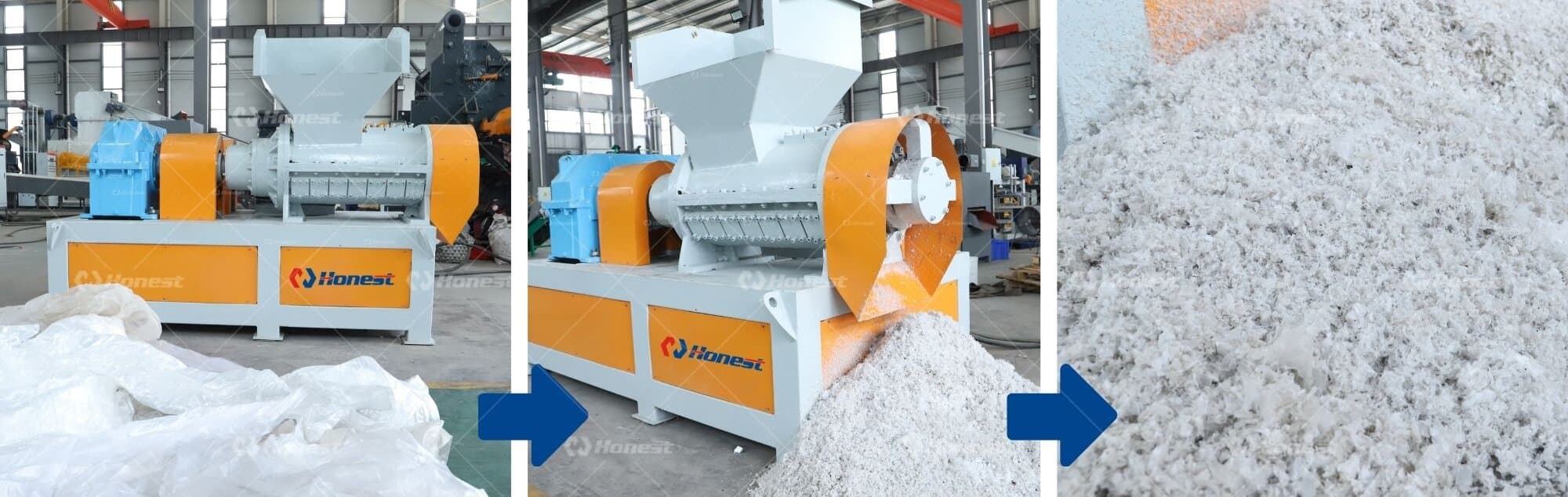 Spiral Shredder Machine for Low-Density Polyethylene
Why LDFilmWaste Remains One of Recycling is Most Difficult Streams — and Why Spiral Shredding Is Becoming a Key Upstream Solution To address this challenge, more recycling plants are deploying spiral shredder systems specifically engineered for soft-film materials. Unlike conventional knife crushers that rely primarily on high-speed impact cutting, spiral shredders operate through a low-speed, high-torque pulling and tearing mechanism. Inside the machine, a spiral blade arrangement actively grips the film, compresses it, and draws it steadily into the cutting chamber before fragmentation occurs. This anti-wrapping structure significantly reduces shaft entanglement, especially when handling agricultural film, waste plastic bags, or heavily stretched packaging film. Because rotational speed remains relatively low, the system also minimizes heat generation, dust formation, and noise—an important factor when processing LDPE, where excessive heat can soften material and affect downstream quality.
Operational flexibility is another reason spiral shredders are increasingly used at the front end of LDPE recovery lines. Output size can typically be adjusted through interchangeable screens or chamber configuration, allowing processors to produce fine particles below 10 mm for intensive washing applications, around 30 mm for standard recycling lines, or coarse fragments up to 50 mm for pre-shredding stages. This adaptability allows one machine platform to support both pre-treatment and secondary size reduction tasks. In practical plant operation, continuous feeding also stabilizes motor load, reducing sudden torque spikes and helping lower unplanned stoppages. Many processors report that improving feed stability at this early stage can increase total production line uptime by 15% to 25%, directly influencing annual throughput and energy efficiency.
Looking ahead, the economics of flexible plastic recycling will depend increasingly on automation, energy control, and the ability to process low-value waste streams with fewer interruptions. Spiral shredding technology does not solve every challenge in LDPE recovery, but it addresses one of the most persistent bottlenecks: unstable front-end feeding. In regions where landfill costs continue to rise and recycled film demand is expanding, improving the first mechanical step can determine whether soft plastic waste remains a disposal burden or becomes a viable secondary raw material stream. For many recyclers, that shift begins not at the washing line or pelletizer, but at the shredder itself.
👉 Contact Tel: +86 199 0388 6476
👉 Contact Email: hnhonest.zack@gmail.com
Related News
- LDPE Film Recycling with Spiral Shredder Technology for Soft Plastic Waste
- Why PCB Recycling Always Starts with Dismantling Before Crushing
- How Large Household Appliance Recycling Companies Turn Waste into Profit
- What are automated solutions for scrap copper-aluminum radiator recycling
- Scrap Rebar Granulator Cutting Machine Detailed Explanation
- Copper and Aluminum Radiator Separator for Scrap Radiator Recovery

Have this news-related demand?
We can help you!
Get in Touch
Connect with us anytime! Whether you have questions, need project assistance, or seek general help, our dedicated team is ready to assist. Fill out the form, and we'll promptly prioritize your satisfaction. We eagerly anticipate serving you.
If you have any requirement or suggestion, please fill in the form and send to us, thanks!
Email: hnhonest.zack@gmail.com
WhatsApp: +86 19903886476
HONEST - Experts in Waste Recycling Solutions
40000
m²
Equipment R&D Factory
2500+
Cases
Customers Worldwide
150+
Countries
Over 20 years manufacturing and 14 years export


