

How to Recycle Blister Pack Waste Efficiently (Complete Industrial Guide)
Blister pack waste is becoming a bigger recycling problem as industries like medicine, electronics, and consumer products grow. Blister packs are made by joining aluminum foil and plastic together by heat, which makes them hard to recycle using regular plastic or metal processes. This mix creates waste that has little value unless special machines are used to separate the materials. As dumping costs go up and rules become stricter, recovering aluminum and plastic from blister pack waste is both better for the environment and a good business opportunity.
Industrial blister pack recycling starts by breaking the packs into smaller pieces. Leftover sheets, extra edges, or used blister packs first go through a crusher to break them up, then through more machines that grind them even smaller. Grinding them in stages is important because it separates the aluminum foil from the plastic, creating a mixture with evenly sized pieces, which helps with sorting later. Having pieces that are all the same size also keeps the recycling process consistent and cuts down on losing material.
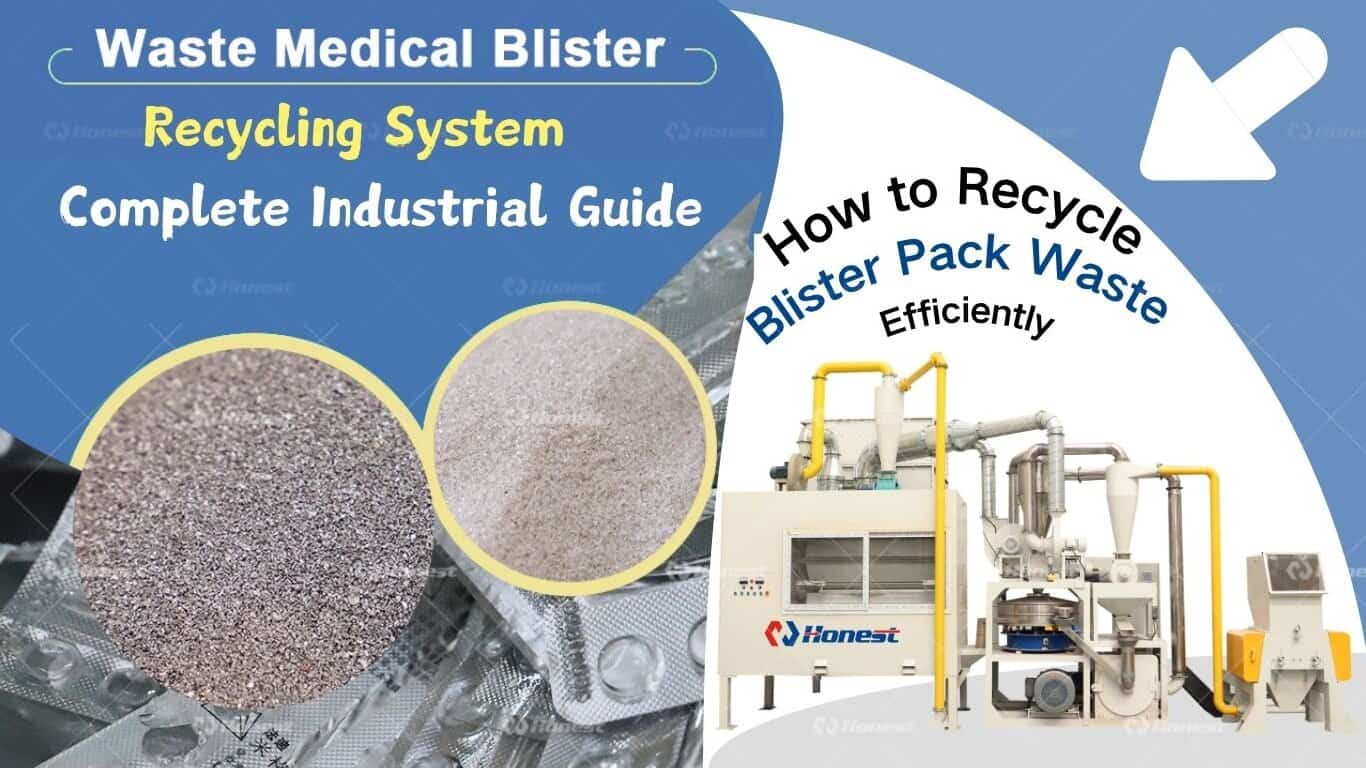 Waste Medical Blister Recycling System
Once the material is sufficiently liberated, separation begins through a combination of air classification and electrostatic sorting. Air separation removes lighter plastic fractions from heavier metallic particles based on density differences, while electrostatic separation performs the final precision sorting by exploiting conductivity differences between aluminum and plastic. Aluminum responds quickly under electrostatic fields, while non-conductive PVC or PET follows a separate discharge path. Under stable operating conditions, aluminum recovery rates can reach 98% to 99%, with purity levels high enough for direct resale to smelters or secondary aluminum processors. The separated plastic fraction can also be reused in industrial products such as sheets, trays, pipes, or cable coatings.
Modern blister pack foil recycling lines are increasingly designed as fully integrated systems rather than standalone machines. PLC-controlled automation allows one-time feeding and coordinated operation across crushing, grinding, separation, and dust removal stages. Water-cooled grinding helps control temperature and noise, while negative-pressure conveying and pulse dust collection systems reduce airborne powder and improve environmental compliance. Compared with chemical or thermal recycling methods, dry mechanical separation offers lower operating costs, simpler maintenance, and faster ROI—making blister pack recycling not only technically feasible, but increasingly profitable for recyclers handling pharmaceutical packaging waste at industrial scale.
👉 Contact Tel: +86 199 0388 6476
👉 Contact Email: hnhonest.zack@gmail.com
Related News
- How to Recycle Blister Pack Waste Efficiently (Complete Industrial Guide)
- Why UBC Debalers Matter in Aluminum Recycling
- PVB Laminated Glass Separator The Definitive Guide to PVB Recovery
- Gold Deplating Machine for Precious Metal Recovery from E-Waste
- PCB and Copper Clad Laminate Recycling Machine for Crushing and Copper Separation
- How PCB Dismantling Machines Improve Copper Recovery in Recycling

Have this news-related demand?
We can help you!
Get in Touch
Connect with us anytime! Whether you have questions, need project assistance, or seek general help, our dedicated team is ready to assist. Fill out the form, and we'll promptly prioritize your satisfaction. We eagerly anticipate serving you.
If you have any requirement or suggestion, please fill in the form and send to us, thanks!
Email: hnhonest.zack@gmail.com
WhatsApp: +86 19903886476
HONEST - Experts in Waste Recycling Solutions
40000
m²
Equipment R&D Factory
2500+
Cases
Customers Worldwide
150+
Countries
Over 20 years manufacturing and 14 years export


