

Home >
News >
PCB Recycling Value Explained: Where Copper, Gold and Tin Are Located in Waste Circuit Boards
PCB Recycling Value Explained: Where Copper, Gold and Tin Are Located in Waste Circuit Boards
Discarded printed circuit boards (PCBs) persistently stand as the most high-value feedstock within the global e-waste recycling industry. They combine base metals, precious metals, and reusable fractions within a compact structure. For recyclers, each ton of waste PCB can contain concentrated copper, tin, aluminum, and trace gold or silver. Therefore, selecting the right PCB recycling machine directly affects recovery efficiency, operating cost, and final resale value.
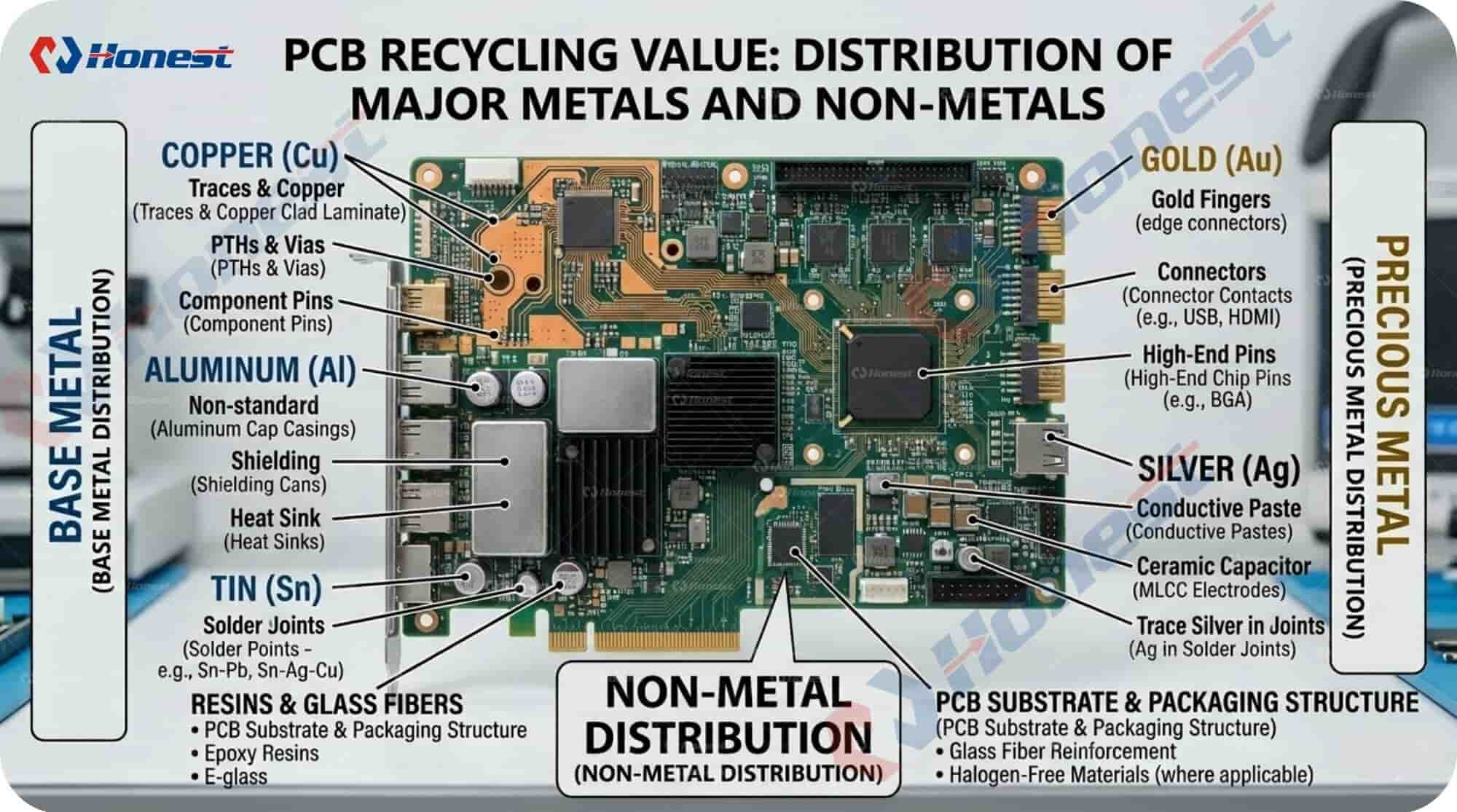
Copper remains the largest recoverable fraction in most circuit boards. It determines the main economic return in copper recovery from PCB operations. High-purity copper is mainly distributed in copper-clad laminate layers, internal conductive tracks, plated through holes, and via structures connecting multilayer circuits. Copper is also found in component leads, solder joints, and connector bases. In practical recycling, this means a waste circuit board recycling machine must first break the board into controlled particle sizes so copper can be fully separated from resin and fiberglass. Better liberation improves electrostatic sorting performance and raises copper purity. This reduces the need for repeated processing.
Before crushing begins, many recyclers now add a PCB Components Dismantling Machine to remove electronic components from waste boards. This step helps separate capacitors, resistors, connectors, and chips before size reduction, which protects crusher blades and improves downstream metal grading. Dismantling also allows valuable components with independent resale potential to enter separate recovery channels, creating additional revenue before bulk material enters the main separation line.
Tin forms the second major metal fraction because it covers nearly every electronic connection with solder. Traditional boards contain tin-lead solder, while modern boards rely on tin-silver-copper alloys where tin often exceeds 60% of the solder composition. Since solder particles easily mix with copper during crushing, stable screen control and uniform particle output become critical inside a PCB recycling system. Buyers evaluating equipment are increasingly focusing on blade wear resistance and screen lifespan, as these factors directly impact separation consistency and maintenance intervals.
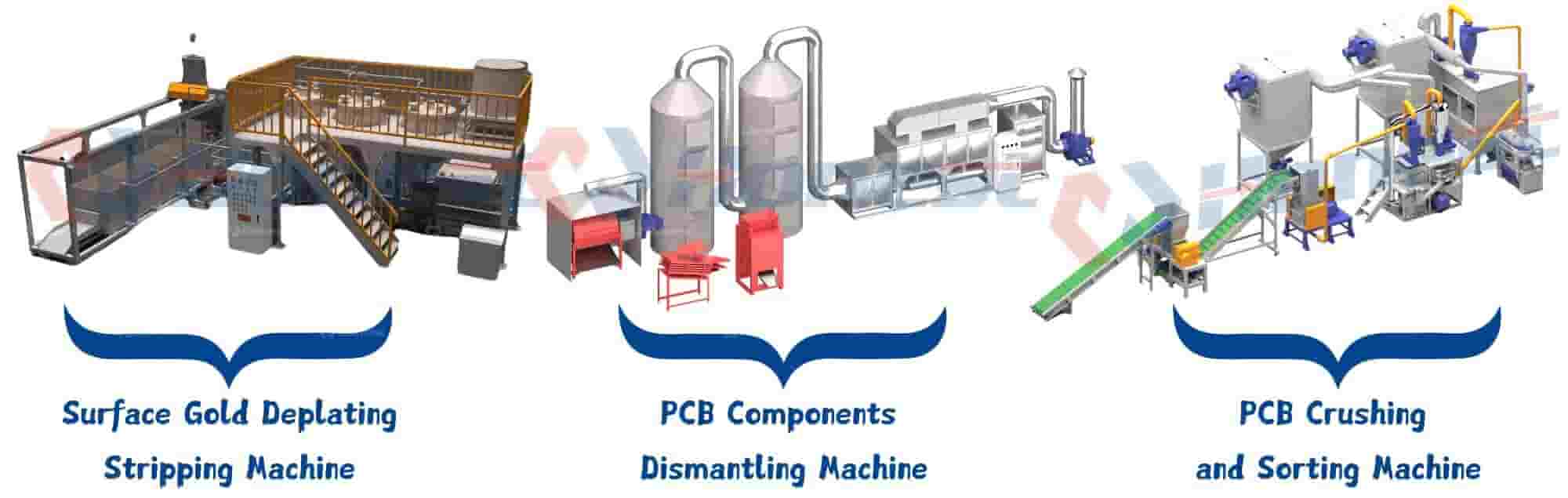
Gold and silver, although present in smaller quantities, often determine the total recovery margin because they are concentrated in highly valuable contact areas. Gold is mainly found on edge connectors, gold fingers, chip pins, and interface contacts such as USB and HDMI terminals. For boards with heavy plated contacts, many recyclers first use a Surface Gold Deplating Stripping Machine to remove surface gold layers before mechanical crushing. This allows precious metal recovery to begin before the board enters the main shredding stage, reducing refining loss and improving overall precious metal yield. Silver is commonly present in conductive paste layers, multilayer ceramic capacitor electrodes, and lead-free solder additives.
Aluminum contributes additional recoverable value through electrolytic capacitor shells, EMI shielding covers, and thermal management structures. At the same time, resin and fiberglass represent the largest non-metal fraction inside PCB waste, which means a complete e-waste PCB recycling line must combine crushing, airflow separation, electrostatic sorting, and dust collection to stabilize output quality. For recycling plants, the real value of equipment no longer depends only on metal recovery rate—it depends on whether every stage, from dismantling to precious metal stripping and final copper separation, converts mixed electronic scrap into predictable commercial output.
👉 Contact Tel: +86 199 0388 6476
👉 Contact Email: hnhonest.zack@gmail.com
Related News
- PCB Recycling Value Explained: Where Copper, Gold and Tin Are Located in Waste Circuit Boards
- Why Dual-Shaft Shredders Remain the First Choice for PCB Recycling Pretreatment
- How Solar Panel Recycling Recovers Copper, Silicon and Glass from PV Waste
- How PCB & CCL Recycling Lines Achieve 99% Copper Recovery
- LDPE Film Recycling with Spiral Shredder Technology for Soft Plastic Waste
- Why PCB Recycling Always Starts with Dismantling Before Crushing

Have this news-related demand?
We can help you!
Get in Touch
Connect with us anytime! Whether you have questions, need project assistance, or seek general help, our dedicated team is ready to assist. Fill out the form, and we'll promptly prioritize your satisfaction. We eagerly anticipate serving you.
If you have any requirement or suggestion, please fill in the form and send to us, thanks!
Email: hnhonest.zack@gmail.com
WhatsApp: +86 19903886476
HONEST - Experts in Waste Recycling Solutions
40000
m²
Equipment R&D Factory
2500+
Cases
Customers Worldwide
150+
Countries
Over 20 years manufacturing and 14 years export


