

Mobile Two-Shaft Shredder Drives Flexible Recycling Operation
As recycling projects become more decentralized and site-based, flexibility increasingly outweighs scale. The mobile two-shaft shredder meets this need by combining strong size-reduction with mobility, allowing operators to process materials at the source instead of transporting them to fixed sites. Compared to stationary shredders, mobile units cut transport distance, handling risks, and logistics expenses—often 20%–40% of recycling costs. Shredding on-site lowers haul volume, improves workflow, and cuts overall operating costs.
Designed for low-speed, high-torque performance, mobile two-shaft shredders are capable of handling a wide range of bulky and complex materials, including electronic waste, scrap metal, industrial filters, pre-processed solar panels, plastic lumps and films, wood pallets, furniture, industrial solid waste, and used tires. The dual-shaft structure delivers a strong tearing force while minimizing material entanglement, ensuring continuous and stable operation even under heavy loads.
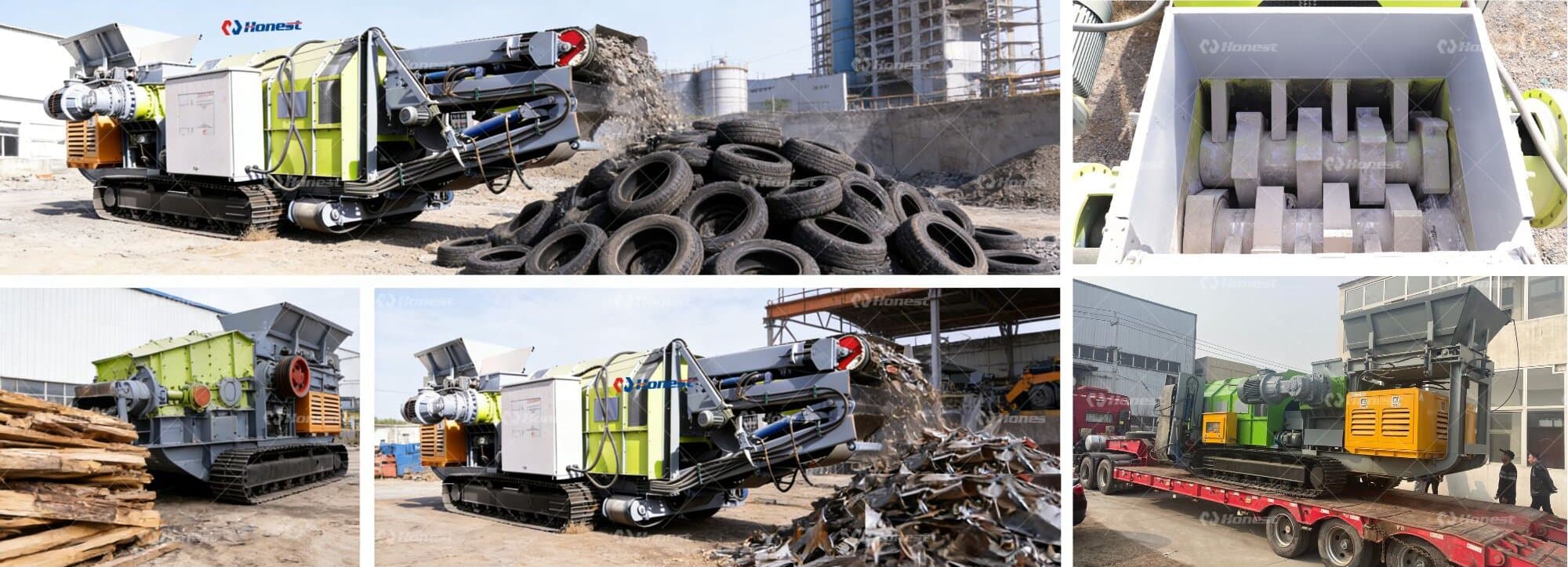
Mobility allows these machines to operate in diverse environments, including construction sites, demolition areas, mining zones, and temporary recycling stations. Reinforced chassis, hydraulic drive systems, impact-resistant structures, and transport-friendly designs such as hook-lift or trailer-mounted configurations ensure durability and adaptability in demanding field conditions. Low-speed shredding also enhances safety by reducing splashing and unexpected material movement, while integrated overload protection, automatic reverse functions, emergency stop systems, and intelligent control panels provide stable and secure performance.
From a business perspective, a single mobile shredder can serve multiple locations, improving equipment utilization and accelerating return on investment. Compared with building multiple fixed shredding stations, a mobile solution offers greater flexibility and lower capital commitment. Modern designs further support profitability through replaceable blades, modular structures, and hydraulic-assisted maintenance systems that reduce downtime and simplify servicing.
Typical tracked models offer power ranges from 190 to 400 kW, rotor speeds of 0–40 rpm, shredding chamber sizes of 1200–1800 mm, shaft diameters of 560–680 mm, processing capacities of 5–20 tons per hour, and total weights between 18 and 35 tons. When selecting a machine, key considerations include material type, required throughput, and working environment. Wheeled units are ideal for flat, hard surfaces, offering lower upfront costs and faster relocation speeds. In contrast, tracked models excel on soft or uneven terrain, providing stronger traction and slope stability at a higher investment level. Most mobile systems use diesel-hydraulic drives for high output and independence from grid access, making the total cost of ownership—including fuel, wear parts, maintenance, and service support—a critical factor in long-term profitability.
👉 Contact Tel: +86 199 0388 6476
👉 Contact Email: hnhonest.zack@gmail.com
Related News
- Mobile Two-Shaft Shredder Drives Flexible Recycling Operation
- Solar PV Panel Recycling Machine for End-of-Life Module Recovery
- Copper Wire Recycling Equipment for Fine and Mixed Cable Scrap
- Detailed Explanation of the Decoating Line for UBC and Aluminum Profiles
- Lithium-ion Battery Black Mass Recovery and Market Value
- How to Build a Profitable Lithium-Ion Battery Recycling Plant

Have this news-related demand?
We can help you!
Get in Touch
Connect with us anytime! Whether you have questions, need project assistance, or seek general help, our dedicated team is ready to assist. Fill out the form, and we'll promptly prioritize your satisfaction. We eagerly anticipate serving you.
If you have any requirement or suggestion, please fill in the form and send to us, thanks!
Email: hnhonest.zack@gmail.com
WhatsApp: +86 19903886476
HONEST - Experts in Waste Recycling Solutions
40000
m²
Equipment R&D Factory
2500+
Cases
Customers Worldwide
150+
Countries
Over 20 years manufacturing and 14 years export


