

How to Build a Profitable Tetra Pak Carton Recycling Plant
With the global transition to circular economy models and eco-friendly packaging, Tetra Pak carton recycling represents a promising long-term investment. Rapid and stable profitability relies on several critical factors: a dependable feedstock supply, robust sales channels, superior-quality pulp output, government incentives, and advanced automation that lowers labor costs. Fundamentally, profitability depends on steady raw materials, value-added recovery, and operational excellence.
The primary focus is securing clean, consistent feedstock. Rather than sourcing contaminated household waste, investors should prioritize industrial suppliers such as Tetra Pak manufacturing facilities, beverage bottling plants, or misprinted batches. These sources provide uniform, food-free material that is easier to process, yielding higher-purity pulp that commands premium pricing. Establishing long-term contracts with municipal waste processors, supermarkets, schools, and beverage distributors further guarantees steady input, enabling continuous production and predictable income.
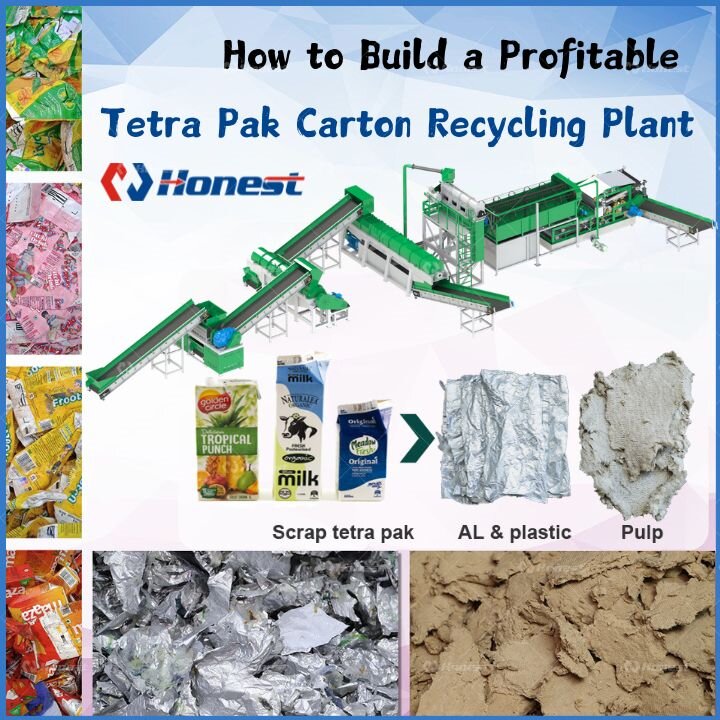 Tetra Pak Carton Recycling Plant
Capacity planning is equally critical. The processing line should match the local collection volume—for example, 500–1000 kg/h—to avoid unnecessary capital pressure or underutilized output. Approximately 75% of beverage cartons consist of high-quality long fibers, which are the primary revenue driver. This premium pulp is widely used by paper mills for the manufacture of cardboard, tissue, and office paper. Efficient separation, proper dewatering, and impurity control increase pulp dryness and purity, reduce transportation costs, and directly improve profit margins.
Controlling operating costs and leveraging policy support further strengthen financial performance. Closed-loop water circulation systems, energy-efficient motors, and PLC automation significantly reduce labor and utility expenses, shortening the return-on-investment cycle. In many regions, recycling technologies aligned with sustainability standards qualify for government subsidies or public–private partnership programs. Cooperation with local authorities can also secure large-scale municipal waste streams. Where domestic demand is limited, exporting recycled pulp to fiber-deficient markets can enhance overall sales value.
Finally, the business model benefits from a “dual-profit” structure: charging waste processing fees while simultaneously selling recovered pulp and clean plastic materials. A complete automated system typically includes a feeding conveyor, a horizontal paper–plastic separator, a pulp-slag separator, a pulp dewatering machine, a filter press, a discharge conveyor, dual water pumps, and a PLC control cabinet, with an optional dual-shaft shredder for pre-crushing. This integrated process ensures stable operation, high separation efficiency, and consistent output of reusable paper and plastic, forming a solid foundation for long-term profitability.
👉 Contact Tel: +86 199 0388 6476
👉 Contact Email: hnhonest.zack@gmail.com
Related News
- How to Build a Profitable Tetra Pak Carton Recycling Plant
- Hydraulic Scrap Metal Baler for Industrial Recycling
- Mobile Two-Shaft Shredder Drives Flexible Recycling Operation
- Solar PV Panel Recycling Machine for End-of-Life Module Recovery
- Copper Wire Recycling Equipment for Fine and Mixed Cable Scrap
- Detailed Explanation of the Decoating Line for UBC and Aluminum Profiles

Have this news-related demand?
We can help you!
Get in Touch
Connect with us anytime! Whether you have questions, need project assistance, or seek general help, our dedicated team is ready to assist. Fill out the form, and we'll promptly prioritize your satisfaction. We eagerly anticipate serving you.
If you have any requirement or suggestion, please fill in the form and send to us, thanks!
Email: hnhonest.zack@gmail.com
WhatsApp: +86 19903886476
HONEST - Experts in Waste Recycling Solutions
40000
m²
Equipment R&D Factory
2500+
Cases
Customers Worldwide
150+
Countries
Over 20 years manufacturing and 14 years export


